Let's all celebrate the release of the only working and legit cheat tool / mod tool for OOC! You will get: free Credits and Messages, yes that's real!!!
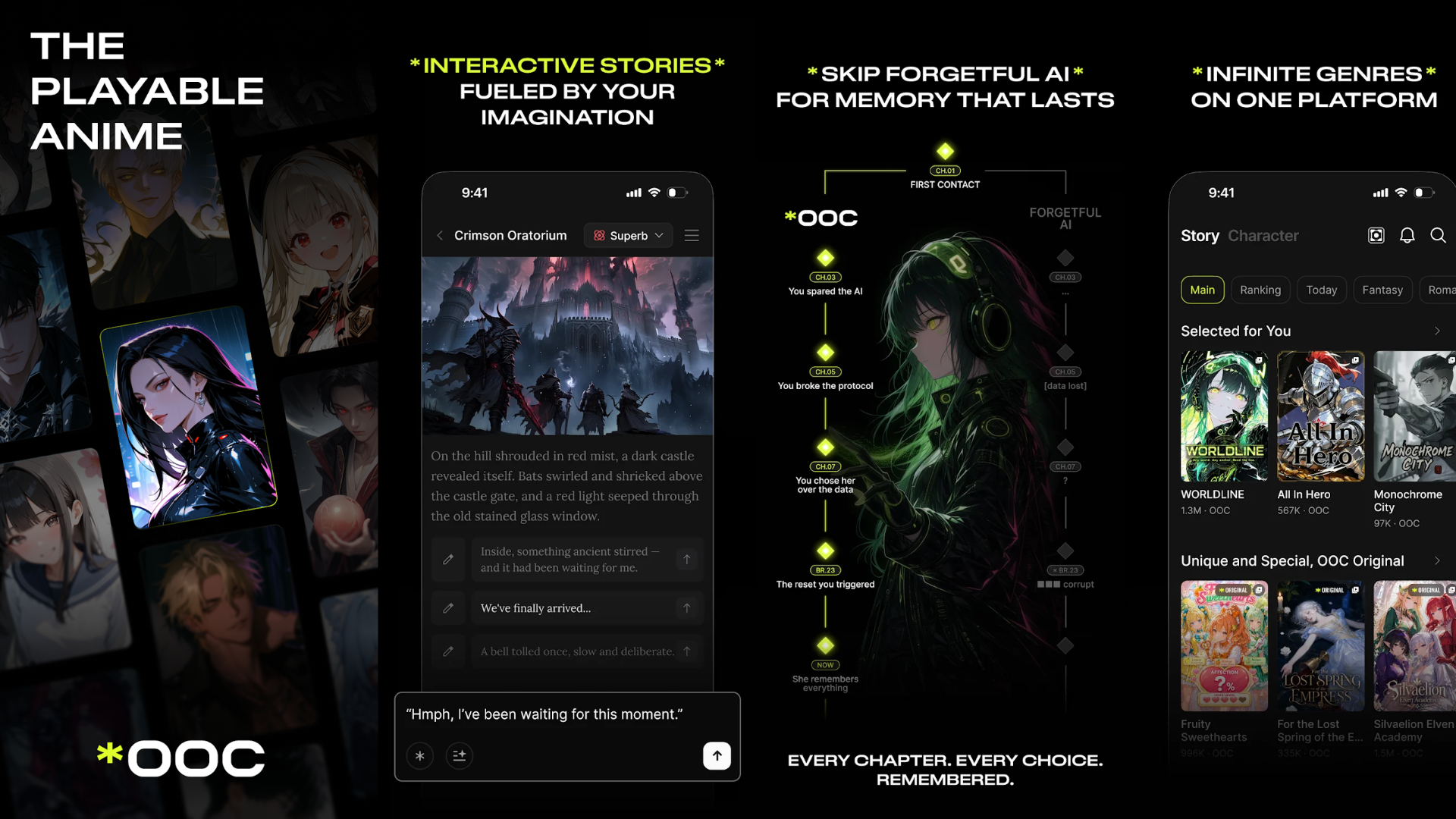
Here’s the pitch, as plainly as I can put it. OOC turns an AI chat into a visual-novel-style adventure, where the publisher supplies a setting, cast, lore, and starting point, and you play the protagonist by typing dialogue, actions, or custom instructions. If you’ve ever wished a visual novel would let you say something that wasn’t one of three pre-written choices, that’s the itch this scratches. You aren’t picking from a menu. You’re writing your own lines and the story answers, in character, with the people and world that someone else built. The scale of the catalog is part of the draw. IGN has described it as more than 52,000 stories and more than 58,000 characters, which is the kind of number that stops meaning anything until you open the browse screen and realize you could spend a year and not touch a fraction of it.
Now to the real subject, which is what the title promised: credits and messages, and the way those two words quietly run your entire experience. Everything good and everything annoying about OOC flows through them, and I think most reviews gloss over how much the economy shapes the way you play. So let me slow down and walk through it the way I wish someone had walked me through it.
Start with credits. Credits are the in-app currency, and the app doesn’t hide that it’s built around them. One industry showcase of the app notes that it uses a consumable credit-based economy rather than a strict subscription paywall, and that matches the feel of the thing. There’s no wall slammed down at onboarding demanding a monthly fee before you’ve seen anything. You get in, you start a story, and the meter only starts to matter once you reach for the more demanding parts of the app. I appreciate that more than I expected to. A subscription wall makes you decide whether you love something before you’ve had the chance to find out. A credit system lets you drift into a story, get attached, and only then discover what your attachment costs.
Where the cost lands is the interesting part. According to one detailed guide I found, Character mode’s Basic model is free, while the structured Story mode and the stronger response modes use credits. That single sentence explains almost everything about how I’d recommend approaching the app. Character mode is the loose, conversational side, where you’re basically chatting with a persona. Story mode is the structured side, with a beginning, stakes, and an arc that can actually end. If you want the cheapest possible hours of entertainment, you live in the free Basic model and treat credits as a luxury. If you want the app’s most ambitious storytelling, you’re going to be spending, and the question becomes how to spend wisely.
This is where messages come in, and where I’ll be careful not to overclaim. In a chat-driven app like this, a message is the basic unit of play: you send a line, the story replies, and that exchange is where the work happens. As I understand the design, the stronger the mode you choose, the more each of those exchanges draws on your credit balance. I couldn’t find a single published price list that I’d trust enough to quote, so I won’t invent numbers. What I can tell you is the shape of it. Credits are the bank account, messages are the individual withdrawals, and the mode you pick sets how heavy each withdrawal is. That’s why two players with the same balance can have wildly different evenings. One spends it all in an hour of rich, cinematic scenes. The other stretches it across a week of quieter exchanges.
I’ll admit this framing changed my habits. When every message costs something, you stop sending throwaway lines. You stop typing “ok” and “hmm” and “go on.” You start writing messages that carry real weight: a decision, a piece of dialogue with some teeth, a specific action instead of a vague one. And here’s the strange part. The stories get better, because a free-flowing AI story rewards specificity. The credit pressure and the quality pressure point in the same direction, which is rare in a monetized app and is, frankly, the best argument for the model.
The steering tools matter a great deal here, because wasted messages are wasted credits. The old roleplay habit I mentioned at the start, the parenthetical out-of-character note, still works as an informal nudge. The guide I read says a short (OOC: ...) direction can still be useful as an informal steering technique, while User Notes and message editing are the app’s documented controls. That distinction is worth sitting with. The parenthetical is a trick you borrow from the roleplay world. User Notes and editing are the sanctioned tools. If a scene is going sideways, I’d reach for the documented controls first, since fixing a reply costs less than burning several messages arguing with a story that has misunderstood you. The app also helps you conserve effort in smaller ways. A creator can provide up to three recommended responses, and if none are supplied, OOC generates suggestions. On a tired night, tapping a suggested reply is the cheapest form of storytelling there is, and it’s a good way to keep a plot moving when your own imagination has clocked out.
So where do credits come from, if you’d rather not open your wallet every time? This is the part I find most reassuring, because it shows the app wants you to keep playing rather than simply charging you. You can obtain credits through purchases, daily check-ins, Challenges, events, referrals, and some creator programs, and the expiration clock depends on how they were issued. That last clause is the one to remember. Not all credits are created equal. Credits you earn from a limited-time event may not sit in your account forever the way purchased credits might, so spending the perishable ones first is simply good housekeeping. I’d treat daily check-ins as a habit rather than a windfall. They’re small, they add up, and they pair nicely with the free Basic model, which means a patient player can keep a surprisingly rich routine going without paying anything.
Events deserve their own mention, because they’re where the economy gets festive. The same guide covers the app’s Halloween 2026 rewards, and it carries a warning I’d repeat in bold if this were allowed to have bold: live event dates can change, so check the event banner in the app before spending anything. Good advice. Limited-time offers are designed to make you feel clever for acting quickly, and the antidote is thirty seconds of checking what’s really on offer. If an event is handing out credits, play into it. If it’s selling you a bundle on a countdown, breathe first.
Let me talk about mobile and PC, since the title promises both and I’d rather be straight with you than bluff. OOC is clearly built phone-first. The showcase I found describes it as an entertainment app with a five-step onboarding and roughly 100,000 monthly installs, and everything about the design, from tappable suggested replies to the visual-novel framing, assumes a thumb and a vertical screen. On a phone, the app’s strengths show: it’s perfect for the commute, the waiting room, the ten minutes before sleep. Short sessions suit a credit economy, too, because you naturally stop when the scene resolves instead of grinding messages out of boredom.
As for PC, I couldn’t confirm an official desktop client, and I’m not going to pretend otherwise. If you’ve found a web version or you’re running the mobile app through an emulator, I can’t vouch for how well your account, credits, and messages carry across, and you should check the store listings and the app’s own help pages before assuming anything syncs. What I can say is what a bigger screen and a real keyboard would change if you get it working. Long messages become effortless to type, and since specificity is what makes these stories shine, a keyboard is genuinely an advantage for anyone who likes to write rather than tap. The tradeoff is that typing longer, more detailed messages on a metered system makes you want to be economical about when you start them. Whatever the platform, the same discipline applies: your balance is shared by your habits, not by your device, so figure out what a satisfying session costs you and plan around it.
Let me be a little more critical now, because a feature that only gushes isn’t worth reading. The biggest weakness of a credit-based design is that it can make you feel like you’re being quietly metered while you’re trying to feel immersed. There’s a particular kind of friction in glancing at a balance mid-scene, wondering whether the next message is worth it, and that friction is the enemy of the fantasy these apps sell. A subscription removes that worry; credits invite it. I also think the free-versus-paid split, with Basic being free and the stronger modes costing, will frustrate some people who feel the free tier is the “lesser” story. That’s a judgment call, and it depends on how much you value the difference. For me the free mode was perfectly fine for casual chatting and the paid modes earned their keep when I wanted a real narrative with an ending.
And endings, honestly, are one of the app’s quiet triumphs. The guide I read explains that stories track Memories, Stats, and Endings, and that’s what lifts OOC above an endless chat. A chat has no shape. A story with stats and an ending does. Knowing your choices feed into something that can conclude gives each message a little more gravity, and it makes the credit spend feel like an investment in a result rather than a drip into a void. If you only try one thing in the app, try a structured story all the way to its ending. It’s the clearest demonstration of what the credits are actually buying.
If you’re a roleplay veteran who already thinks in “OOC” parentheticals, you’ll feel at home immediately, and you’ll probably burn through the steering tools faster than anyone. If you’re a visual-novel fan who always wanted to say your own lines, this is the closest thing I’ve come across. If you’re a spending-averse player, start with the free Basic model in Character mode, collect your daily check-ins, and graduate to Story mode only when something in the catalog genuinely hooks you. And if you’re a parent or just a careful person, treat credits the way you’d treat any in-app currency: set a budget, notice the event banners, and don’t let a countdown timer decide for you.